

Scientists found hedgehogs hear ultrasound, raising hopes for repellents to reduce road deaths.
Researchers at the University of Oxford suggest that ultrasonic repellers could help lower the number of hedgehogs killed by cars. Their idea builds on new research published in Biology Letters, which shows for the first time that hedgehogs can detect high-frequency ultrasound.
The European hedgehog is a well-known and widely loved mammal, yet its numbers are falling sharply. In 2024, the International Union for Conservation of Nature classified the species as “near threatened.” Road accidents are a major factor, with estimates suggesting that up to one in three hedgehogs in some local populations die from vehicle collisions.
European hedgehog. Credit: Tine Reinholt Jensen

The new findings indicate that ultrasonic devices might be used to keep hedgehogs away from roads, potentially reducing these deaths. Until now, scientists were unsure whether hedgehogs could hear sounds in this frequency range.
Lead researcher Assistant Professor Sophie Lund Rasmussen (Wildlife Conservation Research Unit/Department of Biology, University of Oxford and University of Copenhagen) said, “Having discovered that hedgehogs can hear in ultrasound, the next stage will be to find collaborators within the car industry to fund and design sound repellents for cars. If our future research shows that it proves possible to design an effective device to keep hedgehogs away from cars, this could have a significant impact in reducing the threat of road traffic to the declining European hedgehog.”
Scientific Testing of Hedgehog Hearing
To investigate hearing ability, Oxford researchers worked with colleagues in Denmark to measure the auditory brainstem responses of 20 rehabilitated hedgehogs from Danish wildlife rescue centers. The technique involved placing small electrodes on the animals to track electrical signals traveling between the inner ear and the brain while short sound pulses were played through a small speaker.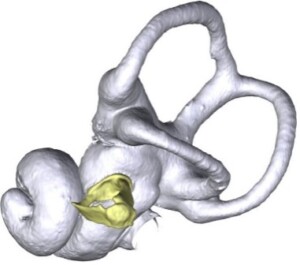
Hedgehog model showing ear bones. Credit: Rasmussen et al 2026
Results showed that the brainstem responded to sounds between 4 and 85 kHz, with the strongest sensitivity around 40 kHz. This confirms that hedgehogs can detect ultrasound, which begins above 20 kHz, and can hear frequencies up to at least 85 kHz. After veterinary checks, all hedgehogs were released back into the wild the following night.
Researchers also performed high-resolution micro-CT scans on a deceased hedgehog (which had been euthanized after being critically injured by a rat trap). These scans allowed the team to create a detailed 3D model of the ear, revealing previously unknown features.
The model showed tiny, dense middle ear bones and a partly fused connection between the eardrum and the first bone in the chain. This structure increases stiffness and improves the transmission of very high-pitched sounds, a trait also seen in animals like echolocating bats that can detect ultrasound.
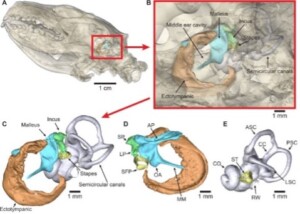
European hedgehog ear anatomy. Credit: Rasmussen et al. 2026
Ear Anatomy and Ultrasonic Adaptations
Further analysis found that hedgehogs have a small stapes, the tiniest middle ear bone that connects the chain of bones to the fluid-filled cochlea of the inner ear. A lighter, smaller stapes can move more quickly, helping transmit high-frequency sound waves. The cochlea itself is relatively short and compact, which supports the processing of ultrasonic vibrations.
These findings suggest that it may be possible to develop ultrasonic repellents that hedgehogs can hear but humans and pets cannot. If effective, such devices could help keep hedgehogs away from roads and other hazards, including robotic lawnmowers and garden strimmers.

Dr. Sophie Lund Rasmussen (aka Dr. Hedgehog) with a European hedgehog. Credit: Joan Ostenfeldt.
Dr. Rasmussen added, “Our novel results revealed that European hedgehogs are designed to, and can, perceive a broad ultrasonic range. A fascinating question now is whether they use ultrasound to communicate with each other or to detect prey—something we have already begun investigating.”
Co-author Professor David Macdonald (Wildlife Conservation Research Unit/Department of Biology, University of Oxford) said, “It is especially exciting when research motivated by conservation leads to a fundamental new discovery about a species biology, which, full circle, in turn offers a new avenue for conservation. The critical question now is whether the hedgehogs respond to ultrasound in ways that might reduce the risks of collisions with robotic lawnmowers or even cars.”
Reference: “Hearing and anatomy of the ear of the European hedgehog Erinaceus europaeus ” by Sophie Lund Rasmussen, David W. Macdonald, Rikke Nora Rosenkvist Hansen, Heidi Maria Thomsen, Henrik Lauridsen, Aage Kristian Olsen Alstrup and Jakob Christensen-Dalsgaard, 1 March 2026, Biology Letters.
For this coming Sunday we are following John and Bev’s (why do we kill hedgehogs)
These European animals are common in UK and Netherlands. They need protection from vehicles, etc. in Europe they designed a way to make ultra sound device on vehicles of 86 KHerz, which is well beyond the Human level of 20 KHrs.
It repells the hedgehogs – they move away, rather than cirling into a Ball (where they could be hammered!)
Have a look at SCI TechDaiLy and TheIndependant